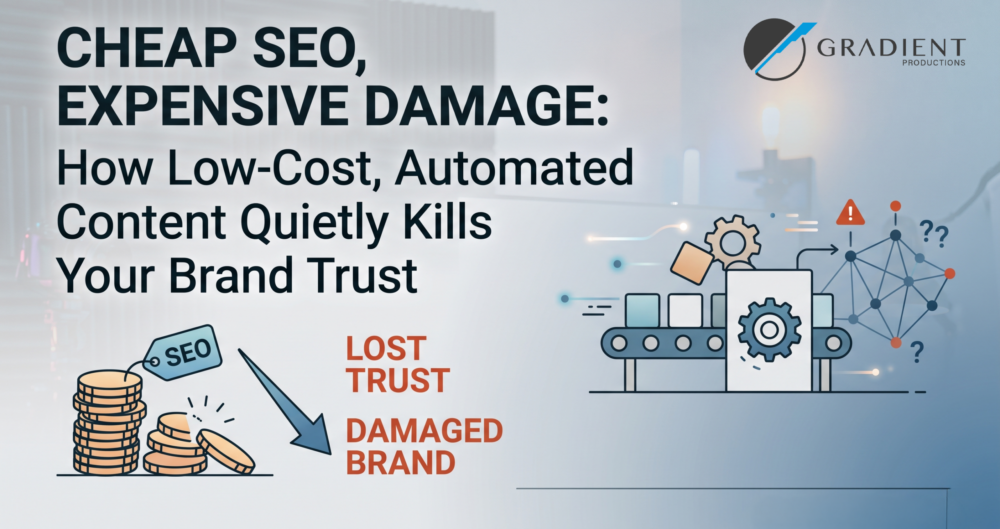
Cheap SEO, Expensive Damage: How Low-Cost, Automated Content Quietly Kills Your Brand Trust

Often, the logic is to “test it cheaply first” by hiring a low-cost agency to publish a few blogs and see what happens. It feels like a responsible, low-risk experiment. However, this mindset is based on a dangerous assumption. Unlike a Facebook ad campaign where you can stop spending and immediately halt the damage, SEO creates a permanent digital footprint that doesn’t disappear when you cancel a contract.
When executed poorly with low-cost automated content, SEO doesn’t just fail to deliver traffic—it actively acts as a slow leak in your brand’s reputation.
Here is exactly how cheap, automated content damages your brand and why it is a liability rather than a bargain.
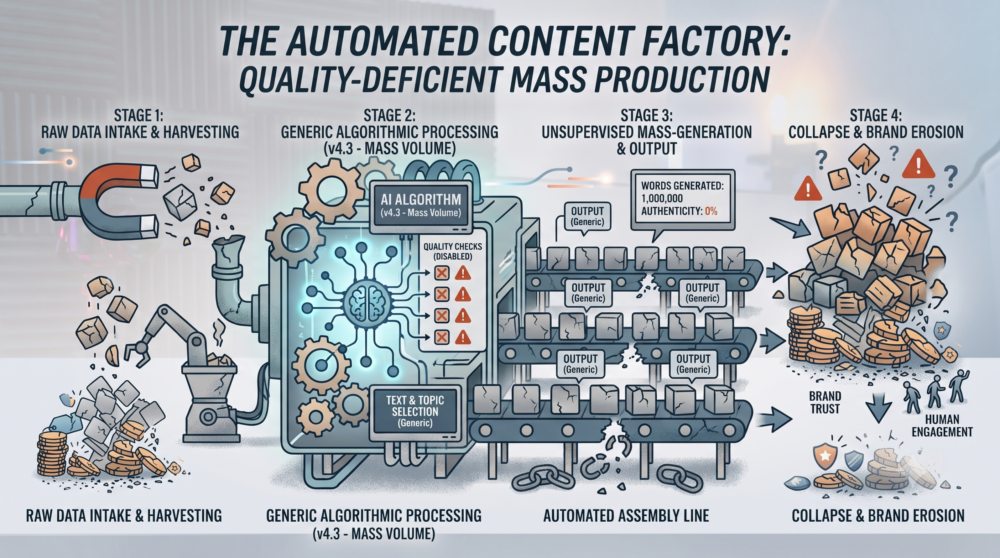
The Automated Content Factory
To justify low retainers, cheap SEO agencies rely on scale and automation. Because they cannot afford custom research or senior strategy, they fall back on a predictable, automated playbook.
- Instead of expert insights, your brand’s blog is flooded with:
- AI-spun or lightly rewritten content designed merely to hit word counts, rather than build real authority.
- Pre-written, generic templates like basic “Top 10” lists that lack original thought and could belong to any competitor.
- Keyword-stuffed paragraphs written for search engine algorithms, completely ignoring human readability and Google’s spam policies.
- Shallow or factually incorrect explanations that oversimplify the complex problems your actual buyers care about.
In this environment, content is treated as a mechanical ranking tool rather than a valuable brand asset.
The "Trust Gap" and Repelling Enterprise Buyers
The most critical shift a business must make is realizing that Google isn’t just a traffic engine; it’s a trust engine.
Long before an enterprise buyer books a demo or fills out a form, they are independently evaluating you. They will read your blogs, scan your pages, and subconsciously decide if you are credible enough to handle a six- or seven-figure decision. Enterprise buyers are exceptionally good at spotting weak, automated content within seconds.
When your content looks low-effort, prospects assume your products, solutions, and team might be the same. This creates a massive “trust gap”. You might successfully rank on Google and attract traffic, but the right buyers will quietly leave. Instead, you will attract price-sensitive, low-intent bargain hunters who negotiate aggressively and churn quickly.
Hijacking Your Brand Narrative
Before a prospect ever speaks to your sales team, your search engine results page (SERP) acts as your uncontrolled homepage. The blog titles, meta descriptions, and featured snippets associated with your domain collectively tell a story about who you are and what you stand for.
Automated, low-cost SEO chases any high-volume keyword it can find, regardless of buyer intent. Over time, Google learns the wrong things about your company. You stop ranking for the core topics you want to be known for, and instead, your brand becomes associated with entry-level problems, generic pain points, and queries meant for industries you don’t even serve.
This brand dilution bleeds into your sales conversations, partnerships, and even hiring, as top-tier talent and collaborators vet you through Google and see a lack of strategic depth.
This will be the main reference for most of the creative team moving forward to assure we stick to the overall tone and feel outlined in the mood board.
The Hidden Opportunity Cost: Lost Years
One of the most dangerous myths is thinking, “At least we’re doing something”.
Because traffic might be going up on a monthly report, leadership assumes SEO is on track, celebrating vanity metrics while sales pipeline quality remains stagnant.
The true cost of bad SEO is not the money spent on the retainer, but the lost compounding effect and wasted years. Once Google’s trust systems associate your domain with low-quality signals, you don’t get to simply “start fresh” when you switch to a premium agency. You will have to spend months, or even years, undoing the damage: rewriting shallow content, fixing keyword cannibalization, and disavowing toxic link profiles.
The Verdict: SEO is Reputation Control
Great SEO resembles digital PR at scale. Every page published is a public statement, and every ranking is a public endorsement.
If your business cannot yet afford serious, expert-driven SEO, the smartest move is not to default to a cheap, automated alternative. It is far better to wait and fix your fundamentals first, because half-baked SEO actively works against you. SEO doesn’t fail because it’s expensive; it fails because cheap execution teaches Google and your buyers not to trust you.
Gradient Productions specializes in taking SEO seriously and doing it right the first time. Contact us today so we can do a deep dive into your busines in order to get the fundamentals dialed in then build a solid platform that focuses on growth and quality.